Showing posts with label Palm WebOS. Show all posts

Saturday, June 6, 2009

Palm Pre Goes on Sale Today


Palm Pre officially goes on sale today from Sprint, its first multi-touch phone and what's been regarded as the most promising contender with the iPhone. Initial reports of stocks show that both supply and demand vary heavily depending on the region: Sprint stores, particularly in major cities like New York, have relatively large supply of as much as 100 or more. However, third-party stores like Best Buy and Radio Shack have relatively much smaller supply and little to no queuing.


Leaks from within Best Buy ahead of the launch had suggested the retailer may not have healthy supply until July this year, prompting speculation either that Sprint's stores were favored much more heavily than others or else that supply was so low that third-party stores couldn't be guaranteed reliable quantity of stock. However, nothing surfaced about Radio Shack's availability ahead of today's debut.

The Pre's key selling point is its webOS, which debuts on the phone. Besides offering a comparatively intuitive, finger-driven interface and full HTML web browsing, it offers a handful of key features that will be absent from its Apple rival even with iPhone OS 3.0, including true multitasking for features such as background Internet radio, universal search that includes Google, Twitter and Wikipedia, and an online sync concept known as Synergy that can merge contacts and calendars from the phone, Google and Facebook while automatically eliminating duplicates. Lighter restrictions on third-party apps allow PalmOS emulation.

A 3-megapixel camera and a slide-out hardware QWERTY keyboard are its key advantages over the current iPhone; otherwise, it has 3G, 8GB of built-in storage, GPS and Wi-Fi much like its key challenger at the $199 price point.

Both Palm and Sprint are depending heavily on a successful launch to turn around struggling businesses but have been helped by mostly positive pre-release reviews that praise the operating system while raising concerns about the keyboard and some minor but notable build quality concerns.

Wednesday, April 1, 2009

Palm WebOS SDK Officially Available


It may not be the announcement most of us are waiting for but definitely this is something that brings us closer to the big event. Palm today announced that the company would begin taking names and numbers on the WebOS dev site for potential mobile developers who are undoubtedly just as excited as everyone else to get an "early look" on the Mojo SDK. Lucky mobile coders will be chosen as early as tomorrow, so hurry up and don't miss this big chance at cracking on the much anticipated WebOS.

Additionally, Palm has announced that MotionApps is creating an emulator application that will allow most Palm OS applications to run on webOS devices. The application, plainly called "Classic," will be available for purchase when the Palm Pre becomes available in the first half of 2009 from Sprint. This will ensure that popular Palm OS applications we've grown, loved and depended upon will continue and optimize to take advantage of everything the new WebOS has to offer.

Since Palm OS applications running in Classic won't be able to leverage core webOS functionality, Palm is working with partners to ensure that popular Palm OS applications are made available on the webOS platform and are optimized to take advantage of everything it has to offer. In the meantime, the MotionApps Classic application will allow customers who have invested in the Palm OS platform to use Palm OS applications they've grown to love and depend upon on their new webOS devices.

Finally, in addition to the early access developer program and classic Palm OS support, Palm is also introducing a new set of "integrated cloud services" for developers called Mojo Messaging Service. Cloud services are software resources provided over the Internet. These services can deliver direct benefits to the end user, such as giving them access to their favorite web applications, or can be incorporated by developers into their applications to enhance the end-user experience.

So there you go. Some significant news for everyone dying of anticipation. Let's hope for much bigger things to come including some definite release date and pricing. We will keep you posted.

Saturday, March 28, 2009

Palm Dished-out Warning at TealOS


Previously, we posted about how you could get a taste of the upcoming Palm WebOS thru TealOS. But now, things are getting too serious. Displeased with others copying their work, PalmInfoCenter reports that Palm snuffed the TealOS skin for PalmOS phones, which imitates the Palm Pre's newer WebOS interface.

TealPoint posted an official response on their TealTalk forum, which basically says that they're shutting down sales and distribution for TealOS on March 30, at the request of Palm. Is Palm overplaying their Pre WebOS too much? Well, as they say... Imitation is the sincerest form of flattery.

Friday, March 20, 2009

A Taste of Palm Pre WebOS


Tealpoint recently released version 1.35 of TealOS. They were marketing TealOS as the next best thing to WebOS.

More than just a visual skin, TealOS is a multi-functional application launcher that gives your time-honored handheld the exciting look and feel of the newest devices. Providing a powerful and intuitive way to organize your activities and work flow, it runs under PalmOS but simulates the card-based interface of webOS on the new Palm Pre. TealOS comes complete with support for thumbnail image cards, a translucent applications screen, customizable background images, customizable icons, a popup wave launcher, and a revolutionary new popup card wave. While keeping your existing phone and applications, it's the next best thing to a brand new phone. - Tealpoint.

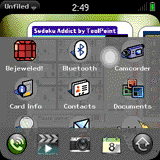
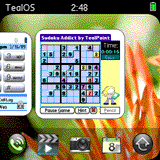
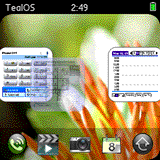
For Palm fanatics who really can't wait for the real one, you can temporarily relieve yourself by installing TealOS onto your Palm device. Perfect on a Palm Centro, the closest thing you can get to a Palm Pre WebOS. Here are some screenies.


Here's another one. A video of Centro showcasing TealOS as WebOS wannabe.


You may try it out here at TealPoint or check out their latest beta 1.38 version.

Saturday, March 14, 2009

Anroidized Palm Pre: Can Android Really Run on Palm Pre ?


It reminded me of Radiohead's song Paranoid Android. I don't know why people would would want Android on a Palm Pre considering how fantastic WebOS looks. They claimed that after a jailbreak (meaning, after hacking), you could possibly install Andriod on a Pre and/or dual boot with WebOS. This is pretty cool, but I’ll probably just stick with WebOS.

The crazy people are even claiming you could run Android inside WebOS much like you can run Windows inside a Mac, which would be interesting to say the least.

Full story quoted below from mypre.com
The Palm Pre isn’t even in users’ hands yet, but already there’s work afoot to Jailbreak the smartphone and load alternative mobile platforms onto it. High on the list of potential OS candidates is Google’s open-source Android, and thanks to some sleuthing around the Texas Instruments OMAP34x SDK it looks like it’s one step closer to feasibility. The route to replacing webOS with Android starts with porting the new OS to the OMAP 3 system, then requires two-stage bootloading before, some further tinkering down the line, you end up with a Pre that’s dual-bootable into both webOS and Android.

In fact Android has already been ported to OMAP 3, by the OmapZoom team. To get around the Pre’s lack of microSD card slot - as the T-Mobile G1 is bootloaded via memory card - the suggestion is that the smartphone’s support for USB Mass Storage mode could allow hackers to place the Android OS in the user storage section, and merely point the initial bootloader to those files.

All this will require a serial over USB driver to access the Palm Pre’s bootloader and Linux core; you can guarantee that such a project will be a key priority when the Pre finally launches. Not only would it allow for dual-booting or alternative operating systems, but native software such as has been written for the iPhone and iPhone 3G. Alternatively, you could even load an instance of Android within webOS.

Wednesday, March 11, 2009

Battle of the Mobile OS's: A Short Roundup


I still remember the days of Palm vs. Pocket PC, Palm OS vs. Windows Mobile. They're back, but this time, it's a four-way battle. The stakes are higher, and the operating systems are more powerful than ever. Who do you think will win the race? or at least the race to your wallet.


iPhone OS X

A slimmed-down version of Apple's OS X is at the core of every iPhone and iPod Touch. With such a powerful operating system, the iPhone can run apps that belong more on your Mac than on a mobile phone, and play games that belong more on a gaming console.


Google Android

Yes, typical of Google, the version of the Android operating system found in the HTC G1 is practically still in beta development. Despite this, all the nerds are a-buzz with the possibilities of Android. Its open architecture -- familiar to Linux fans -- allows anyone to develop applications for Android phones, as well as make improvements to the OS itself.


Palm WebOS

Palm's brand new operating system. WebOS is slated to power all Palm devices for the foreseeable future. Comparisons to the iPhone have been drawn with WebOS's familiar navigation, but crucially, WebOS is capable of a few things OS X can't do: multi-tasking with its "cards" system, and cut and paste.


Windows Mobile

Windows Mobile is the self-same operating system that ran your old Pocket PC PDA. Since then it has undergone radical cosmetic surgery, a heart replacement and about a gazillion nip tucks here and there. Still going strong. Windows Mobile is your first choice if connecting to enterprise networks is your priority. Word has it that WinMo 6.5 has some nifty visual tweaks.